Prepare Now Thrive Later - Your US RN Priority Date Game Plan
Good morning, good afternoon, and good evening—wherever you are listening in from, thank you so much for joining us today. Welcome to Onwards and Upwards, where you learn everything you need to know about living and working in the United States as an international clinician.
My name is Deirdre O’Regan. I am your host for today, and I am very excited about our show. We have some amazing guests who will be sharing their experiences and expertise with you.
So what do we have coming up today?
We know that last month there was some very exciting movement in the Visa Bulletin, which may have made many of our viewers visa-eligible or close to it. Today, we’re going to focus on preparation—what you need to do as your priority date becomes current, or if it already is.
We’ll discuss how to prepare from an English exam perspective, how to prepare financially, and what kind of research you should do to ensure you are ready to thrive once you arrive in the US.
Before we bring our guests on, I would love to see where our viewers are tuning in from. I see we have Melvin from the Philippines—welcome, Melvin. We also have Fuja from Kuwait—welcome. And Janet from Zimbabwe—welcome as well. We are very excited to go through today’s content with you all. Preparation is key.
Please pop your questions into the chat as we go through the session. We will answer as many as we can, and as we introduced in our last show, we also have an exciting new segment at the end to address what’s on your mind. So make sure to send in your questions.
And as always, if you are excited about today’s discussion and have not yet applied, please do so. We are here to help you take the next step in your journey. You can apply at amnhealthcare.com/international. We will continue to share the link throughout the show so you can apply and let us help you with the rest.
Now, without further ado, I would like to welcome our panel for today.
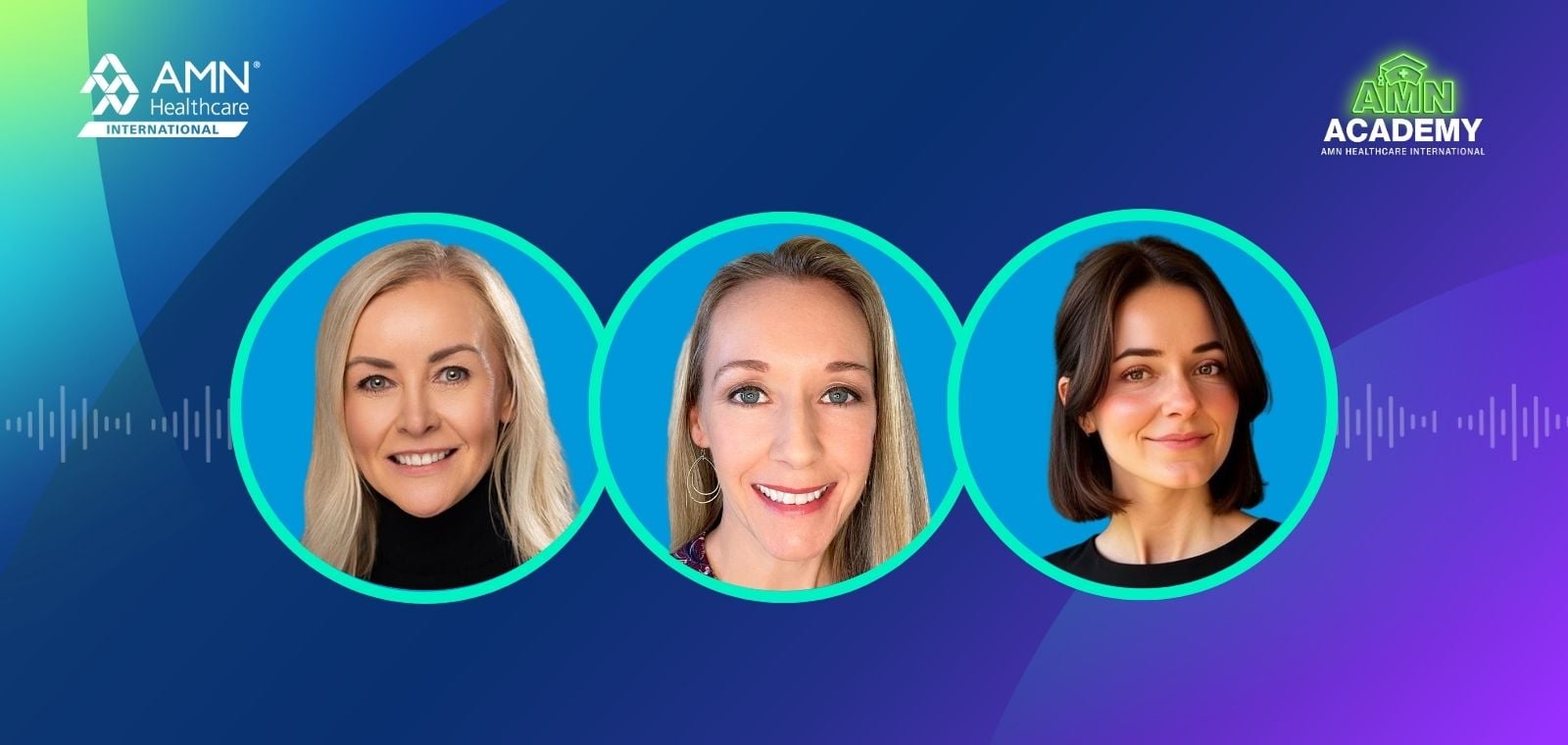
We have Nina Pitches, Manager of our English Program at AMN Healthcare International. She will talk about how you can prepare for English exams and the support and resources available to you.
We also have Victor, one of our international nurses who is currently in the US. He will share his experience, including how he prepared, the challenges he anticipated, and how AMN supported him through his transition.
We also have Anastasia. Thank you for joining us. Anastasia is currently in the process of preparing to come to the US, so she will provide a valuable perspective from someone at that stage of the journey.
And last but not least, we have Crystal, Manager of our Onboarding Program at AMN International. She will talk about how you can prepare for arrival in the US, what to expect, and most importantly, the support AMN provides to ensure a smooth transition.
Before we begin, I’d like each guest to briefly introduce themselves.
Let’s start with Victor.
Hi, my name is Victor. I am from the Philippines. I moved to the United States in July 2023. I came through AMN/OGP, and I started my first assignment in Rock Hill, South Carolina. I am still in my first hospital assignment, and I never left. I’m still here and I’m happy with it.
That is what we love to hear, and that is the goal, right? The goal is that when you accept your placement, you love it so much and we make such a perfect match that you decide to stay there long term. So I am very excited for you—what a beautiful part of the country. We’re looking forward to hearing all about what it’s like to live and work there.
And now, let’s hand it over to Nina.
Hey, thank you so much. Hi everyone, my name is Nina Pitches. I am the Manager of English and Credentialing here at AMN International. I oversee everything related to your English testing and visa screening to ensure your process stays on track as you move toward your green card interview.
I have been with AMN for almost nine years now, and I have worn a few hats along the way. I started on a pre-NCLEX program on the licensure side, then moved into licensure endorsement and credentialing. Now I support nurses through the English process.
You may hear it a little in my accent—I am originally from Germany, and I have been living in the US for about 10 years now. So I do understand some of the challenges that come with being a non-native English speaker and adjusting to a new life and a new country.
I look forward to sharing a few tips, and I am excited to be here today.
Thank you so much, Nina. I have been very blessed to work alongside Nina for eight of those nine years. So thank you for being here, Nina. We’re also excited to hear about your experience as an immigrant and how you adapted to speaking English regularly. You are certainly an expert who can help guide others through this process.
Now, Anastasia, over to you. Could you please introduce yourself to our audience?
Hello everyone. My name is Anastasia I am from Nairobi, Kenya, and I am a registered nurse. I have been working as a registered nurse for over 15 years.
I am glad to be here to share my experience. I went through a lot of struggles at first, but finally, with the assistance of AMN, I was able to become successful. Thank you.
Thank you. We are very excited to hear about your journey, and we truly appreciate our international nurses taking the time to join us today. We know you are all very busy, and your perspective is incredibly valuable for those preparing to come to the US.
Last but not least, let’s go to Crystal.
Hello, it is such a pleasure to be speaking to all of you from around the world. My name is Crystal. I manage the onboarding team, so when you reach my team, it is go, go, go, go, go time.
Hopefully today we can share a few tips that you can start using now to help make your transition smoother later on.
Wonderful, thank you Crystal. I am loving the guitars behind you—do you have a secret talent we don’t know about?
My dad has a secret talent.
Well, that is very fun!
Alright, let’s get started. Victor, I’m going to start with you—and forgive me, do you prefer Victor or Jose?
Victor.
Perfect. So Victor, when you decided you wanted to work abroad and move from the Philippines, why did you choose the US?
Yeah, actually, before I moved to the US, I was working in the Middle East—I worked in Saudi Arabia. I also had friends who were working there with me, and they were living proof and testimonies of how good the US is.
So I decided to give it a try and take the NCLEX, and I can truly attest that I did not make a mistake. I am very proud that I took that big step of moving here.
Yes, in the Middle East you can earn money and a decent income, but when it comes to family and work-life balance, the USA is much better. I think that was the turning point for me—it was about my family.
The USA is more family-oriented, while I feel the Middle East is more temporary.
And we hear that a lot, right? Many international nurses go to other countries first to gain experience, and it becomes a stepping stone toward the United States, especially because the process can take time.
So if I’m hearing you correctly, work-life balance and family were very important to you, and that was one of the main reasons you chose the US. We are very happy that you chose the US and that you chose OGP, our staffing division of AMN International.
So why did you choose OGP?
OGP, I would say, has an excellent reputation in helping nurses live and succeed here in the US. I actually have a lot of friends who are OGP nurses or AMN nurses, and they all have very good feedback about you.
You are doing great work, and I am very proud to be an OGP nurse. Wherever I go, I can say I am from OGP, and it gives me a sense of pride.
As a newcomer here in the States, I really appreciate the effort and support you provide to international nurses. I am very thankful for everything. I truly would not have been able to manage this journey with my family without your help.
So thank you so much—I will always be grateful.
Amazing. Thank you, Victor. We could not ask for a better ambassador. That is incredible.
What is also very meaningful is that Victor has completed his commitment, but he chose to stay at the facility where he was originally placed. Yet he remains part of the OGP and AMN International family.
Once you join us, it is for life. Even after your commitment period ends, we are still here for you throughout your entire US journey. We truly appreciate you coming back to share your experience with us.
Thank you so much.
Actually, I chose AMN because I had many friends who had already gone to the US, and I always heard them talking about AMN—“AMN is good, kindly join AMN.”
I was always wondering where to start, and for many years I didn’t have the courage to begin the NCLEX process. I don’t know why, but I kept thinking maybe I wouldn’t make it.
But when I finally made up my mind that this is what I wanted—that I had to relocate—I took the NCLEX and passed.
I then learned about AMN through a very close friend. When I applied to AMN, I received very strong support, and I am truly grateful. I am still in the relocation process, and they have been extremely supportive. I am just very thankful to AMN International.
Thank you so much, and we're grateful to have you here today. So Anastasia mentioned that, you know when she decided she wanted to pursue opportunities here in in the US. She didn't know where to start, right? So we hear that a lot is like, how do I start? So if you are listening in today and you have passed your your NCLEX, where you start is by applying to us today, and let the experts guide you on next steps. So let's pull up the handle again. Amn healthcare.com, forward slash International. That is where you start, because it can be daunting, it can be a stressful process, and so you do need a partner who's been doing this for a long, long time. We have been helping international nurses and their families relocate to the United States for 40 plus years. So we have helped 1000s of nurses like Victor and Anastasia reach their American dream, and we are excited to to help you along your journey as well, regardless of what stage in the process you are. So one of the big things that is necessary to prepare for when coming to the United States is taking your English exam, and that can be daunting, that can be stressful, but it is a it is an urgent and really important part of your process. So Nina, you are a manager of our English program here at amn International. So can you give us a brief overview of our English program and how you and your team support nurses taking the English exam
of course? So we're actually partnered with 9.0 Niner for English prep. So once you. Sign your contract with us, and once your iPhone 40 is filed with us, you'll automatically get the registration info to access all of those free resources. So yeah, they're free, so there's nothing that you need to pay for. The program itself is self study, which is great since I know a lot of our watchers have very busy work schedule schedules, but it's also very interactive, so you get full English review materials that break down each section of the exam. You also get mock exams so you can really see where you stand before your test day. And they also offer live webinars where the instructors go over common problem areas and test strategies, especially for speaking, which I know is usually the toughest, and honestly, my favorite part of what NID offers is the one on one coaching, so you can book time directly with a coach to work on your weak areas, get that feedback and ask questions. And we do see that nurses who actually use this feature tend to feel a lot more confident going into the exam. So overall, it's a really solid program, as long as, of course, you engage with it consistently and use all of the tools that are available to you. So as soon as you sign up with us, we can get you started and get you enrolled on that platform and help you be successful in your English exam.
Okay, so I heard a couple of key things there. I heard that the program is free at no cost to you, and that there is support and one-on-one coaching. All of those things are designed to make the process of taking and passing your English exam much less daunting.
Victor and Anastasia are also going to share their English journeys with us today, which will provide helpful tips, encouragement, and motivation to take the next step and get your exam scheduled.
Crystal, can you give us a brief overview of what our onboarding process looks like and how your team supports international nurses like Victor and Anastasia in relocating to the US? So once that visa is in your hand, it is go, go, go time. Processes change rapidly, so we are always staying up to date with the current requirements.
We help you with everything you need to get settled as quickly and smoothly as possible. This includes guidance on how to obtain your Social Security number as fast as possible, resources for opening bank accounts, and information on the best banks to use.
We also coordinate your airport pickup, housing arrangements, and other key logistics. From the moment you land, we support you with transportation, hotel check-in, and all the essentials you need when arriving in a new country.
Essentially, we help you get your head wrapped around everything involved in immigrating and settling into the US so you can transition as smoothly as possible.
Thank you very much, Crystal. I love how excited you get with “go, go, go time!”
I hope everyone listening is just as excited as we are to get you here and ensure you have all the support you need so you can focus on being the amazing nurses that you are—and let us handle the logistics for you.
When we kicked off the show, we talked about the Visa Bulletin advancing last month, which was very exciting. We are expecting a new Visa Bulletin in the next week or so. We’re not sure what it will look like, but hopefully we will see similar movement. With that, many of you may see your priority dates become current.
But let’s go back to basics for a moment and remind ourselves what a priority date is and why it is so important.
If we can run a quick clip from one of our Onwards and Upwards Immigration Shows a few weeks ago, our partner attorney will explain.
Attorney (clip):
So the priority date is the date your I-140 is filed—not the prevailing wage determination, which is not nurse-specific, not when postings are filed, and not when all your documents are submitted. It is the date your I-140 is filed with USCIS.
Here is why it is important: USCIS has a quota on the number of green cards issued each year. Every month—usually around the middle of the month—the U.S. Department of State releases the Visa Bulletin.
The Visa Bulletin is a chart that lists every country in the world along the top, and different visa categories along the side.
For nurses, the most relevant category is usually EB-3. You check your country of birth along the top, and EB-3 along the side. You will see a date listed. If there is no backlog, you may see “C,” which means current.
“Current” means there is no retrogression, and your case can continue moving forward through the process toward your green card.
Okay, lots of information there to unpack. I would encourage everyone to tune in to our Onwards and Upwards Immigration Show next week, where we will answer more of your immigration questions in detail.
Now, I think we may have lost Victor—these things happen in a live show, so we will continue.
Anastasia, you are currently in the preparation stage to relocate to the US. What phase are you in right now, and how are you preparing?
Thank you so much. I am currently waiting for my I-140 to be approved, and I am preparing for my next step, which is the fee bill.
I am also preparing myself financially and gathering information for the next stages. Whenever I have questions, I raise them with AMN, and I receive a lot of support. All my queries are being addressed, and I am very grateful for that support.
Are you getting excited?
I’m so excited.
Absolutely, yes—we’re excited for you as well. I’m sure you’re working closely with Crystal’s team, and we’ll get into that a bit more as we go through the show.
Victor is back. Hi, Victor. This is live—these things happen with technology. We’re just going to roll with it, and if that happens, just jump back in whenever you can. We’ve got plenty to talk about.
So Victor, a quick question for you. When you were preparing to come to the US, is there anything you wish you had done sooner to prepare—anything you delayed or would do differently?
Yeah. The one thing I regret is that I should have started my NCLEX right after I graduated. At that time, most of my friends were already in the US while I was still in the Middle East.
In fact, I feel like I should have been with them already. I delayed my process, and I paid the price for that delay.
My encouragement to younger nurses is this: once you finish your nursing degree, start the process immediately. The US nursing journey is not something that happens overnight—it takes time. There can also be delays along the way.
I remember that before, some nurses waited almost 10 years due to visa backlogs. For us, we only waited about two years, and my friends would say, “You are still lucky—you only waited two years compared to others who waited 10.”
But still, I think if I had started my NCLEX and paperwork earlier, I would have arrived in the US sooner.
So for all the young nurses out there: start the process now. Don’t delay it too long.
And that also applies to your English exam, because NCLEX and English go hand in hand—they are equally important. So please don’t delay taking your English exam.
Nina, I want to come to you. In your experience working with many nurses in our English preparation program, how does delaying the English exam affect them from a timeline perspective?
That’s a really good question.
When your English test gets delayed, everything else gets delayed as well. You need English clearance for your visa screen, so if you don’t take the exam early, your visa screen is also delayed. That can take several months to complete, and it may also impact your visa interview readiness and even your overall immigration timeline.
What often happens is that nurses come under a lot of pressure trying to book exams last minute, and that stress can negatively affect their performance.
I also see many nurses delay using the resources already available to them once they start the process. Some enroll in our review program but don’t fully commit to it. As a result, they don’t really address their weak areas in English, and those gaps show up on exam day—which is exactly what we want to avoid.
English is one of the few parts of this journey that you can control. Nurses who start early, stay consistent, and take the exam when they are ready move through the process with far less stress.
Starting early really does change everything.
Thank you so much, Nina, and that is straight from our experts. So start preparing now if you are not already doing so.
We’re going to get Anastasia’s and Victor’s perspectives on their English preparation journey in just a moment.
But we do have a question that just came in from Erica that I would like to address.
Erica is asking: Do we have both staffing and direct hire opportunities, as she unfortunately had her job offer rescinded?
Yes, Erica—we do. And we would be honored and thrilled to help you continue your US journey. Our team of expert recruiters is ready to support you.
We’ve just shared the link again: amnhealthcare.com/international.
We do offer both staffing and direct hire opportunities. We’re very sorry to hear about your situation, but this is not the end of your journey—it is simply a pause, and we are here to help you move forward.
We also did a show a few weeks ago discussing current market conditions in the US. We’ll drop the link in the chat so you can review that as well.
Now, Crystal—many of our viewers are either newly visa-eligible or about to become visa-eligible. We’ll go into more detail on preparation shortly, but very briefly, what are the top two things they should be focusing on right now?
Well, like Nina said, focus on the things you can control—control what you can control.
You are looking for green lights when it’s time to travel, so you need to be ready to go when that time comes.
I would say the most important things are:
First, being ready to travel.
Second, having enough money saved.
And third—yes, I know you said two—but I would add having your driver’s license ready as well.
You want all of these things prepared in advance. You don’t want to be scrambling once your visa is issued and trying to book flights or sort out essentials at the last minute.
So focus on what you can control right now, while you are not yet under pressure. That preparation will make everything smoother later.
Thank you so much, Crystal. I love those visuals—“go, go, go” and “green lights.” It really captures the excitement of this stage.
You’ve spent a lot of time preparing for this moment, so don’t delay yourself further with things you can already control—like your English exam if you haven’t taken it yet.
Before we go back to Anastasia and Victor to talk about their English preparation experiences, we’re going to have a bit of fun.
We’ll do a quick quiz, so please join in and put your answers in the chat. It’s a true or false game.
Question 1:
Changes in the monthly Visa Bulletin impact my immigration timeline.
Victor, what do you think—true or false?
Victor: True
Correct—the answer is true.
Question 2:
After my priority date becomes current, I still have several months to prepare for my departure, so I don’t need to do anything immediately.
That is false. As we discussed earlier, preparation should happen in advance.
Question 3:
IELTS, TOEFL, PTE, OET, and MET are all universally accepted, and I can take any of them to meet my English requirement.
Nina, over to you.
Nina: That is false. Not all exams are accepted everywhere. It depends on the program and requirements.
Correct—that is false. Please make sure you consult with our experts to confirm which English exam is accepted for your specific pathway.
Now, Anastasia—you have successfully completed your English preparation and passed your IELTS exam. Congratulations.
Can you talk to us about the challenges you faced during your preparation and how you overcame them?
Thank you. So actually, my journey to passing IELTS was a bit tough because I took it twice.
The first time I sat for the exam, I did not pass. In my country, I started by joining an IELTS class. Unfortunately, I had this mindset that since English is widely used in my country and I can speak and understand it, I didn’t need to practice much. I thought I could just join the class and be fine without much preparation.
But I was wrong. I didn’t realize how much practice I actually needed and how important it was to join the right support system.
So the first time I took the exam, I didn’t get the required band score. I was very discouraged. I remember texting Nina and sharing my results, and she encouraged me not to give up and to try again.
That gave me courage. I then joined 9.0 Niner and became very serious with my preparation. I took time to really understand what IELTS was about—the speaking, reading, writing, and listening components.
By the time I took the exam the second time, I was very confident. Even my spouse, who accompanied me, noticed it and said, “You look very confident this time.” And I said yes, because I knew that with the preparation and support I had, I was going to achieve a good band score.
And that is exactly what happened.
So I would encourage anyone who has failed before or thinks IELTS is easy not to underestimate it. Take time to prepare, join a structured program, take the lessons seriously, and practice consistently. That is what helped me pass.
I was very happy after passing because I knew I was finally ready to move forward. I am very grateful to AMN. Thank you so much.
Thank you, Anastasia. That is a really powerful story to share.
So you were not successful the first time, and we hear that often. Even if you speak English regularly, IELTS preparation is very specific and requires focused practice. That is why we offer this program free of charge—to help you prepare properly and succeed on your first attempt.
But what’s important is that you didn’t give up. You came back stronger, more determined, and with better preparation. Nina and her team supported you through that process, and congratulations on passing your second attempt.
Now it’s behind you, and you can look forward to the next steps with Crystal’s team as you move toward your US journey.
Yes, I’m very happy to share my experience.
It took me about three to four months to finally pass my IELTS. I also took it twice—the first time I failed, and the second time I passed.
During my first attempt, especially in the speaking test, I felt intimidated by the examiner. I feel like I didn’t perform at my best because of that pressure.
There are many review materials available, including those from AMN and YouTube, but one thing I want to share is that it’s also about mindset.
You need to condition your mind. During the speaking test, you should think of the examiner as someone you are simply having a conversation with—not someone superior to you. They are not your boss. They are just there to assess you.
When I changed my mindset like that on my second attempt, it boosted my confidence. It helped me eliminate fear and intimidation, and I was able to speak more freely and express myself better.
I also continued using review materials and practiced mock exams every week. I told myself, “I already paid for this exam, so I will not take it again.” That mindset really helped me focus.
For me, it was all about mindset—and it worked.
Thank you. So both Anastasia and Victor have shared that they did not pass their English exam on the first attempt.
The most important thing is to stay motivated and continue using the resources provided to you free of charge through AMN International. Our goal is always for you to pass on your first attempt, but if for any reason that doesn’t happen, come back to us—we are here to help you.
So if you are listening today and you have not yet scheduled your IELTS exam, take Anastasia and Victor’s stories as encouragement. We know it is not easy, and we know it can feel daunting, but support is available.
If you are not yet utilizing the English resources we offer—or if you would like to—please reach out to us at amnhealthcare.com/international. We would be happy to enroll you in our program and support you in your English preparation journey.
I have one more question for Nina and Crystal before we move on to what preparation looks like for coming to the United States.
Nina, we are getting a lot of questions in the chat: When should I take my IELTS exam? At what stage in my process should I take it?
That is a very important question.
As soon as you receive your Niner registration information, we recommend signing up right away and completing the full review within about 90 days. After that, you should plan to schedule your test within the next 60 days.
Try not to prolong it. You’ve already taken the time to study and prepare, so don’t let too much time pass between completing your preparation and taking the actual exam.
Ideally, from start to finish, you should aim to complete and pass your English exam within about six months.
There is a common misconception that nurses should wait until they are visa-eligible before taking English. That is not true.
The main reason you need to pass your English exam is for your Visa Screen, and that Visa Screen is required for your embassy appointment. Once you pass English, we will process your Visa Screen before your English results expire, and that Visa Screen is valid for five years once issued.
Most US states also do not require current English scores for licensure after that, so the likelihood of needing to retake the exam is very low.
The biggest takeaway is: do not delay. Testing early keeps your case moving and helps prevent immigration delays. The earlier you pass, the smoother your entire process becomes—and the less stress you carry moving forward.
Thank you so much, Nina. That is great advice.
There is also a common myth that people delay taking English because they are worried it will expire. At AMN International, we ensure that your Visa Screen process is handled in time so that does not become an issue.
So it is very important to take your English exam as early as possible. If you are unsure or receiving conflicting information, always come back to the experts for the correct guidance.
Crystal, one final question on English before we move on to financial preparation and relocation planning.
How does delaying the English exam impact the onboarding and relocation timeline?
If you delay your English exam, you are taking a risk because you don’t know what will happen with the Visa Bulletin each month.
It comes out every month, and it can move forward or backward—we never know. If you delay your English exam, you could miss your window. You might become visa-eligible and ready for consular processing, but if the bulletin moves backward the next month, you’ve lost that opportunity.
Even if everything else is ready, without English clearance you still cannot proceed.
So it really affects your timeline significantly. You don’t want to leave something you can control up to chance. When the bulletin moves backward, we don’t know when it will move forward again.
Delaying English adds unnecessary risk to your journey, and that is something you want to avoid.
Thank you so much. Lots of great information and advice today regarding English preparation—especially around not delaying and making sure you take your English exam regardless of where you are in the immigration process.
If you take just one thing away from today’s show, let it be this: I need to schedule my English exam or I need to start preparing so I’m ready to take my English exam.
Please take that step, and let us help you move forward.
Now we’re going to switch gears and talk about financial preparation for coming to the United States.
Victor, I’m going to ask you a question. When you first arrived in the US, were there any expenses that surprised you or that you weren’t fully prepared for?
(We may have lost Victor—don’t you just love live shows?)
Oh, he’s back!
Hi, Victor. Did you hear the question, or would you like me to repeat it?
Okay, we’re having some technical difficulties, so I’m going to come back to Crystal for now.
Crystal, what does financial preparedness actually look like? We hear this term a lot when nurses are preparing to relocate with their families—but what does it really mean in practical terms?
It means having enough money. That’s really what financial preparedness is—it means being financially ready for the transition.
And that includes planning ahead for where you are moving and understanding the cost of living. For example, how much is rent going to be? How much will transportation cost? How much will your flight cost? Especially if you are booking flights for a whole family—that is already a significant expense.
Financial readiness also means being prepared for arrival expenses like transportation, possibly purchasing a car, licensure-related fees, uniforms, and initial living costs.
Depending on your employment model—whether staffing or direct hire—you may need to cover rent for the first few months before your first paycheck arrives.
Then there are everyday essentials: food, household items, and basic furniture. Many people underestimate this, but even simple things like a mattress, pillows, and bedding can cost several hundred dollars if you are starting from scratch.
Financial readiness really means having a clear plan in place so that when you arrive, your biggest concern is not “How will I survive financially?” but instead, everything is already covered.
That peace of mind—knowing you have enough saved and planned—is what allows you to focus on settling in and starting your new life successfully.
Thank you so much. So hopefully that helps.
Preparation is really key, and there are many things you need to prepare for from a financial perspective—especially if you are bringing a family. Another important factor is your destination within the US.
For example, if you are going to a high cost-of-living state like California or New York, your financial preparation will need to be different compared to going to a more rural or lower cost-of-living state.
To give you an example:
If you are a single nurse and you are relocating to Tennessee, we generally recommend having around $6,000 saved to make your transition as smooth as possible.
However, if you are going to California or New York, we recommend closer to $10,000 to $15,000, because the cost of living is significantly higher.
If you are bringing dependents, we also recommend adding approximately $1,000 per dependent to ensure your transition is not financially stressful.
Now, that may sound like a lot—and it is—but that is exactly why preparation is so important. Regardless of where you are in the immigration process, start preparing now so that finances are not a source of stress when you are ready to travel.
This is also where research becomes very important, especially when deciding where you will be located in the US. We will talk more about that shortly—what you should research before accepting an opportunity in the US.
I think we have Victor back.
Victor, were there any expenses that surprised you when you first arrived in the US?
Yes. One thing that really surprised me was insurance.
In the Middle East, I didn’t have to pay for insurance, but here in the US, you have to pay for different types of insurance—car insurance, health insurance, and sometimes even life insurance.
That was something new for me.
But like what has been said, you really need to prepare financially before coming here. While waiting for your flight, take time to save money because you will need it when you arrive.
Yes, everything is available in the US, but you should not be tempted to spend on things you don’t really need right away. Especially when you first arrive, you will see many things in malls and stores that are tempting, but it’s important to be disciplined.
Save your money for what is necessary first.
That’s really great advice, Victor—especially about being mindful of spending when you first arrive.
Okay, great. So you’ve been getting a lot of support from your AMN International team on what to expect and how best to prepare.
But the key takeaway from this part of our show is this: start preparing now. Regardless of what stage you are in your immigration journey, begin preparing financially today to make your transition easier—especially if you are traveling with your family.
Nina, you mentioned at the top of the show that you are an immigrant yourself, having moved from Germany. Can you briefly share what your experience was like coming to the US and how you adjusted so successfully?
Yes, of course.
I think for me, the biggest adjustment when coming to the United States was understanding that knowing English and communicating confidently are not the same thing.
I learned English in school in Germany, but it still took time for me to speak it comfortably in everyday life. In the beginning, I often worried about how I sounded and whether my grammar was correct.
Another thing that surprised me was how much Americans enjoy small talk—casual conversations about your weekend or asking how you are doing, even from people you don’t know. That took some getting used to.
Accents were also a challenge. The first place I lived was in Georgia, and many people there have a strong Southern accent, which takes time to adjust to. Depending on where you are placed, you will hear many different accents, and that can be an adjustment at first.
But what helped me most was letting go of the fear of making mistakes. People are not focused on perfect grammar—they are focused on understanding you and helping you. Keeping that in mind really made a big difference for me.
Great advice. Thank you so much, Nina. I really appreciate that.
And yes, Nina is currently in Georgia, and she previously lived there for many years before relocating to the beautiful state of Arizona. We were sad to see her leave, but excited for her to experience more of the country. It really is a beautiful part of the US.
That brings us to our final segment of today’s show: what you should be researching before arriving in the United States.
There are 50 states in the US, and many of you may already have your placement and have begun researching. Others may still be deciding where you and your family want to live—especially if you have friends or connections in certain areas.
Crystal, what should our audience be researching before arriving in the United States? And if we can bring up the slide, we can go through the top four areas.
That is an excellent question.
First, you want to research the cost of housing in the city you are moving to. You are not selecting your exact apartment yet, but you need to understand the average cost.
Inflation is affecting housing everywhere. If a friend moved a few years ago, their experience may be very different from today.
Right now, moving into an average cost-of-living area can easily require $4,000 to $5,000 upfront, just for move-in costs. That does not include utilities, food, or transportation—it is strictly what you owe the landlord or property.
We recently had a nurse move to Washington, DC, who paid about $17,000 upfront just to secure her apartment, and she still had to cover the first month’s rent before receiving her first paycheck.
You should expect first and last month’s rent, plus deposits and fees.
Second, research transportation. In most cases, you will need a car. Even if you consider Uber or taxis, those costs add up quickly and can often exceed a car payment, especially in large cities like Southern California or Washington, DC.
Third, look into the community you are moving to. Sometimes living 20–30 minutes outside the hospital is more affordable and more comfortable than living right next to it.
Finally, make sure you have an accurate picture of where you are going. If you imagine the US as one big city but you are actually moving to a rural or suburban area, it can feel very different than expected. For example, places like Danville, Pennsylvania are much more rural than many people anticipate.
Having realistic expectations helps reduce stress and makes your transition much smoother because what you experience will match what you prepared for.
Thank you, Crystal. Our team is here to support you in understanding what you need to be prepared for and to assist you with any research depending on where you are going. Whether you already know your location or are still deciding between a few options, we are here to guide you.
If my advice could be summarized simply: if you receive a good offer and it feels right for you, consider accepting it promptly. We don’t know what will happen with the Visa Bulletin in the coming months, so timing can be very important.
Now I want to ask Victor and Anastasia for some final words of advice for our audience.
Anastasia, let’s start with you—what advice would you give to someone who is ready to take the next step toward coming to the United States and choosing a partner to support them in this journey?
The advice I would give to anyone who is unsure where to start or feels stuck is to simply apply with AMN Healthcare.
They are very kind and very supportive. That has been my experience. I have received incredible support through every challenge along the way.
So I would encourage everyone to take that first step.
Thank you, Anastasia. We look forward to having you join us again when you are in the United States—we cannot wait for that moment.
Victor, any final words of advice you would like to share with our audience?
Start. Start now.
Taking the first step is always the hardest part, but once you take it, everything else starts to follow.
The people at OGP and AMN are great. They are very supportive. Even though I am already out of the agency, I still stay in touch with them.
So be brave. There is no place in the US for fear. Be courageous. And if you don’t know something, ask—because if you don’t ask, you will never know.
If you need help, ask these people. They will help you find the answers you need.
Thank you so much to our panel today. We could continue this conversation for hours, but unfortunately, we are out of time.
I want to sincerely thank Nina, Crystal, Victor, and Anastasia for sharing their journeys and for all the valuable advice they have given today. These insights will truly help our audience prepare for the next step in achieving their American dream.
Before we close, I also want to address “what’s on your mind.”
We are seeing many questions in the chat about travel bans and recent immigration updates. Please join us for our Onwards and Upwards Immigration Q&A next week, where our expert attorney panel will discuss these topics in detail.
That session will be on April 17, and we encourage you to join us.
As we know, May is Nurses Month, and our May 1 episode will focus on the DAISY Awards. We previously had a wonderful episode featuring international DAISY Award winners, and we look forward to continuing that celebration.
A quick reminder: on the AMN Academy, we offer OET preparation courses on the first and third Monday of each month. On the fourth Monday, Joy Bansag will host sessions on Dream Jobs.
There has been a lot of discussion today about English preparation. The most important takeaway is this: do not delay. Prepare today.
Whether you are close to visa eligibility or already in the process, take action now and let us support you every step of the way.
If you are ready to take the next step, you can apply at: amnhealthcare.com/international
If your job offer has been rescinded, we do have both staffing and direct hire opportunities available. Our team is highly experienced in recapturing priority dates, and we have been supporting international nurses for over 40 years.
We are here to help turn this into just a pause in your journey—not the end of it.
Thank you for joining us today. Thank you for all your questions, and a special thank you to our panel for being here.
Until next time—onwards and upwards.