
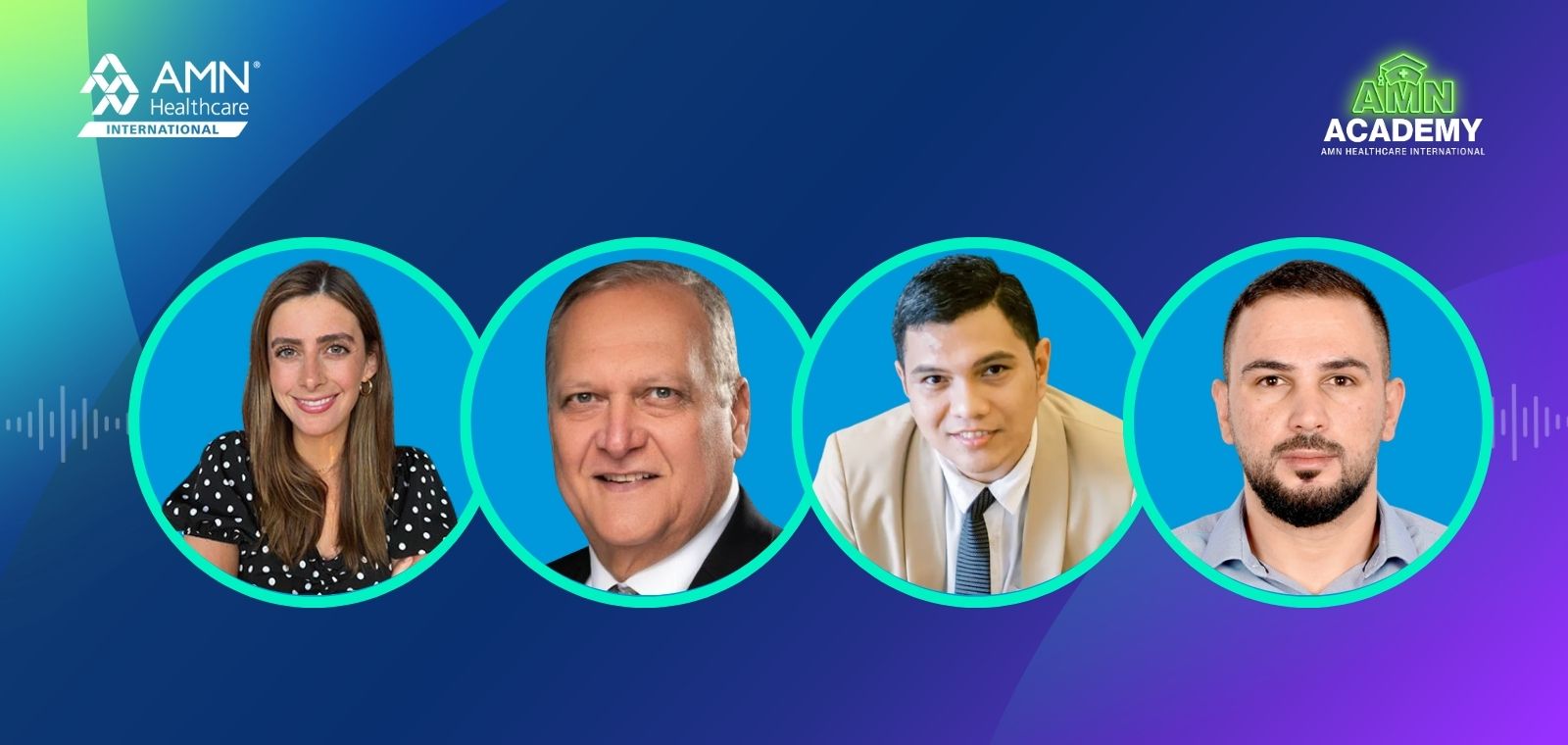
Recapture Your Opportunity Turning Setbacks Into Succes
Good morning, good afternoon, and good evening, wherever you may be watching from. Welcome to AMN Healthcare International’s live show, Onwards and Upwards!
This is the show where we discuss everything global healthcare workers need to know about living and working in the United States.
Good morning, good afternoon, and good evening, everyone! My name is Danielle Freedman, and I will be your host today. I’m coming to you live from San Diego, California, where AMN Healthcare is headquartered.
If you are joining us for the first time, welcome! And if you are one of our regular viewers, thank you for sticking with us and continuing to learn with us through our weekly shows. We are so happy to have you all here today.
AMN Healthcare is the largest provider of international staffing and direct-hire positions across the United States. If today’s show inspires you and you would like to begin your American dream, we’ll be dropping the application link in the chat. You can apply at:
Our recruiters are on hand, ready and waiting to help you achieve your American dream.
Today, we have a very special show. We’ll be discussing a topic that gets a lot of attention, and today we’re doing a deep dive into it. Our topic is: “Recapture Your Opportunity: How to Turn Setbacks into Success.”
We’ll be talking all about priority dates, recaptures, rescissions, and many other terms you may have seen or heard recently.
We would love for you to share your questions and comments in the chat. We also enjoy seeing where everyone is joining from, especially since we have viewers from all over the world.
So good morning, good afternoon, and good evening to:
- Gladys from the Philippines
- Puli from England
- Ngozi from Nigeria
- Muhammad from London
- Long Gail from South Africa — a fellow countryman of mine, as I’m also from South Africa!
- Anson from Kenya
Thank you all for joining us today, and please don’t forget to leave your questions and comments in the chat.
Without further ado, let’s welcome our guests for today’s show.
How are you?
I am doing well. Good morning! How are you both doing?
Good! It looks like we can see Ed, we can see Mark, and there’s Mohammed. Thank you all for being here with me today. I’m very excited to hear about your journeys and expertise.
Let’s start with a few introductions and some background information so our viewers can get to know you better.
Ed, why don’t we start with you?
My name is Ed Scornia, and I’m the Senior Director of Operations and Technology at AMN Healthcare International. I’m an engineer by background and specialize in business operations. I’ve been in the healthcare staffing industry for over 25 years.
Lots of experience! For those of you watching, Ed is usually my go-to person whenever I have questions about almost anything — he really knows everything. So I’m very excited to have him joining us today. He has a lot of expertise and knowledge to share. If you have any questions for Ed, please put them in the chat, and we’ll be sure to ask him.
Alright, Mark, let’s hear your background and story next.
Hello, everyone across the globe! I’m Mark Garvey Numa. I’m happily married to my God-fearing wife, Zendy, and we are blessed with two beautiful daughters, Diana and Minea.
I’m a proud USRN, entrepreneur, Bible-believing Christian, and keynote speaker. As a registered nurse from the Philippines, I’ve been able to live my dream here in the United States, and now I’m on a mission to empower others to do the same. Thank you.
I love that, Mark. What a wonderful introduction. Thank you so much for sharing a little bit about your family. We’re looking forward to hearing more about your journey to becoming a USRN.
Mohammed, let’s hear from you next.
Hello, my name is Mohamed Ellis Goul, and thank you for having me here today. I’m originally from Jordan and came to the United States from the UAE. I’m here with my wife, and we have three children.
I think we lost you for a second there, Mohammed — I’m not sure if that was my internet or yours — but I did hear the important part: you have three children and your beautiful wife is there with you as well.
We’re excited to hear more about your journey, from Jordan to the United States, and what you’re doing now.
So for today’s show, we’re going to focus on recaptures, rescissions, and other topics that can definitely make your heart skip a beat. These situations can feel a little scary — I can see Mark nodding because he’s lived through this experience and probably knows exactly how that feels.
But before we dive into all of that and explain what these terms mean, I’d first like to focus on the positive side and where you both are today. You are both USRNs now.
Mark, can you tell us a little bit about your life today — where you live and how it feels to be a USRN?
Okay, life has been amazing.
I’m grateful for this opportunity, and it has been very fulfilling. It’s been a big adjustment, but I’m loving every minute of it.
Being a healthcare professional in the US is truly rewarding because this profession is highly valued here. It’s very clear that my skills are appreciated and needed — and so are yours.
One thing I really appreciate here is the principle of work-life balance. Especially here in Jackson, Mississippi, it’s a wonderful place to live and work.
So I would also like to invite international nurses to come to Mississippi and practice your profession here.
Thank you, Mark, for sharing that. I think you touched on something we’re definitely going to discuss later in the show — what it’s like to be a USRN, the importance of work-life balance, and how nurses in the US are truly valued.
I think that’s something very important for our viewers to keep in mind as they consider beginning their own journeys.
So we’ve heard Mark’s story from Mississippi. Mohammed, can you tell us a little bit about your journey and where you are living and working today?
I think it has been a long journey until I came here, but it has also been a very nice journey. I’m enjoying life here, especially the work-life balance.
It has truly been a great journey, and in the end, it’s really worth it. I believe everyone should keep trying, stay patient, and continue moving forward because eventually you will get here — and when you do, it will all be worth it.
Well, thank you for sharing that, Mohammed.
It sounds like both of you are truly living your dreams. You’ve made it to the other side of the process, you’ve come to America, and you are now both working in the US.
For a little bit of background — and please correct me if I’m wrong — Mark, you originally started on a direct-hire journey, then later transitioned into a staffing journey, and now you are working on a staffing contract in Mississippi.
And Mohammed, you also started on a direct-hire journey, but your employer rescinded your contract. After that, you were able to find another direct-hire employer. Is that correct?
I think that sounds right. I see everyone nodding their heads.
And I think these two stories really show that the journey is not always a straight line. It’s not always simply one step followed by the next. As I see Mark nodding, sometimes there are twists and turns along the way.
And I think that’s very common. A journey is not always a straight path.
Why is that more common than nurses may think?
Ed, can you tell us a little bit about that?
Yeah, if you think about it, there are a lot of things that need to come together. The main factor is the immigration pathway, along with the relationship between the nurse and the healthcare facility.
From an immigration standpoint, there are many things happening — visa retrogression, pauses, bans, and different parts of the immigration process. One of the biggest factors is the slow advancement of the Visa Bulletin, which creates a much longer timeline.
Years ago, it may have taken only 12 to 15 months to come to the United States. Now, the process can take around three years. And within a three-year period, a lot can happen.
That’s where the complexity comes in. People’s personal circumstances can change, immigration processes continue to evolve, and hospital staffing needs also change over time.
I think we have two successful nurses here today who made it through the process successfully. For me, the most important thing is to keep the vision alive:
I want to come to the US.
I want to get my green card.
I want to become a USRN.
The timeline may not always be ideal, but the key is figuring out how to stay committed and make the journey successful — even if something like a rescission of a job offer happens along the way.
I think that’s a very good way of putting it, Ed. I can see Mark nodding in agreement.
I’d like to dive a little deeper and better understand what a rescission actually is. Ed, can you explain what it means and why it happens?
A rescission happens when you have a job offer from an employer, but the employer later decides that they no longer want to move forward with employing you. This can happen for a variety of reasons.
A lot of it is connected to what’s happening in the healthcare industry right now. Many hospitals are focused on profitability and making sure they can meet patient care needs efficiently.
When immigration delays occur, hospitals lose predictability regarding when nurses will actually arrive. For example, if they expect a nurse to arrive on a certain date but the process is delayed by another year, they often cannot continue waiting indefinitely.
As a result, hospitals may pursue alternative staffing solutions such as hiring new graduates, travel nurses, or local direct hires. They must ensure they have enough staff available when needed.
That’s part of the complexity that leads some employers to change their commitments and rescind job offers.
So what I’m hearing, Ed, is that many of these factors are outside of the nurse’s control. A rescission is not necessarily based on the nurse’s performance. Would you say that’s correct?
Absolutely. In most cases, it is not because of the nurse’s performance. Often, the hospital’s needs simply change. Budgets may shift, staffing priorities may change, or patient care trends may evolve.
For example, many hospitals are seeing more services move toward outpatient care, which means they may not require the same acute care staffing levels as before.
That said, there are still some factors that nurses can control. There have been cases where rescissions happened because nurses did not complete their English exams on time or required multiple attempts without passing.
So there is also a responsibility on the nurse’s side to stay actively involved in the process. Some nurses may leave bedside care during the waiting period, and employers may see that as a concern.
Having current clinical experience is important because employers want to ensure your skills remain aligned with their needs.
But overall, if nurses stay committed to maintaining their skills, remain engaged in the immigration process, and stay connected with their employer, they can successfully work through the journey.
Thank you, Ed. I think that’s really good advice and helpful background for nurses who may be hearing this term for the first time.
A rescission can feel very scary. It can feel like a huge bomb has been dropped on you — like suddenly your journey is not going the way you thought it would.
I see Mark smiling and nodding because he experienced something very similar. Mark, you were on your journey when your contract was rescinded. Can you tell us a little bit about how that felt and how AMN supported you through the process?
Yes. At first, when I heard the news, it was a shock to me.
I had already set my mind on the fact that we would soon be leaving my home country and moving to the US. We were already preparing for that transition.
It was definitely a tough pill to swallow. I felt lost, but I never gave up. Instead, I focused on exploring other options and staying positive.
At first, I thought my chance to work in the US had become much harder and that I would have to start all over again. But I reminded myself that setbacks are often opportunities for something better.
So I chose to see it as a chance to explore other avenues and continue making my dream happen.
And thankfully, AMN was there to support and guide me through the process.
Well, that definitely warms my heart because that’s exactly what we want to do. We want to be there for you during the good times and especially during the difficult moments.
Like you said, hearing that news after already preparing for your move must have been a huge shock. But you stayed positive, explored other opportunities, and now here you are in the United States. That’s truly amazing.
Mohammed, can you tell us a little bit about what your experience was like when your contract was rescinded and AMN helped you get recaptured?
And I see we have another fellow US green card holder joining us! Hello! Welcome to the show. Who do we have here?
Oh, you’re on mute, Mohammed.
I think this is one of Mohammed’s three children who traveled here with him. Is that right?
Yes, that’s right. This is Ahmad.
Hello, Ahmad! How do you like living in the United States?
Well, hopefully Ahmad is enjoying life in the US, playing sports, making friends, and having fun experiences. That’s exciting!
So Mohammed, I wanted to ask you about the moment when you found out your contract had been rescinded and AMN helped you get recaptured. Can you tell us more about that experience and how it felt?
Yes. Actually, when we received the news about the contract rescission, it was really overwhelming.
When you first hear that kind of news, your reaction is almost, “What just happened?”
At that moment, you feel hopeless and unsure of what to do next.
That’s why I’m truly thankful to AMN because they gave us knowledge, guidance, and clear next steps. They reassured us that it was not the end of the journey.
There are many myths out there that once a contract is rescinded, everything is over. But that’s not true. You can still continue the process, find another employer, and move forward using the same immigration process.
There may be a delay, but you can still achieve your goal.
When AMN reassured us and explained the next steps clearly, it really helped us move forward with confidence.
It looks like we lost Mohammed for a moment there, but something he said really stood out to me. He mentioned feeling hopeless and helpless when he first heard the news.
And I’m sure many nurses watching — or those who may have experienced this themselves — can relate to that feeling. It can be very frightening not knowing what comes next or what your journey will look like.
As we’ve discussed today, the journey is not always a straight line. But even when challenges happen, there are still opportunities to move forward.
I’m glad Mohammed was able to find another employer with AMN’s support, and now he is successfully living and working in the United States.
I think Mohammed touched on something very important. Ed, I’d love to get your perspective on this.
Both Mohammed and Mark had to be flexible during their journeys. Mark transitioned from a direct-hire employer to a staffing employer, while Mohammed continued with another direct-hire employer.
Why is flexibility so important for nurses during this process, especially when unexpected changes happen? And what advice would you give?
Absolutely. We speak with many nurses, so we understand the emotional challenges they face.
When something like this happens, it can be very shocking. Many nurses need time to process the news because it affects their confidence and creates uncertainty about their future pathway.
What’s important to remember is that companies like ours are experts in this industry. We understand the process and have strong relationships with healthcare facilities.
That’s why it’s important to align yourself with a trusted partner — someone who can guide and support you through the journey.
Trying to navigate everything alone can be very difficult emotionally and professionally. Having a trusted company to guide you step by step provides reassurance and helps you continue moving forward with confidence.
You know, once something like this happens, connect with us — whether it’s through the recruitment team, your case specialist, or another member of your support team — and we can provide the proper guidance you need.
Thank you, Ed. I think that’s really important to keep in mind if something like this ever happens to you.
As always, if you’re concerned about your journey or have questions, talk to your support team. Here at AMN, you have a full team supporting you throughout the entire process. They can help guide you, navigate the situation, and figure out what your next steps might be.
And I think that’s so important because making this transition is a huge life decision — especially for nurses like Mohammed and Mark, who moved with their families. You want to know that you are working with a company you can trust.
Ed, I feel like you have something else you want to share. I can see it!
I do. I just want to highlight that AMN Healthcare International offers a lot of options for nurses.
One pathway is staffing, also known as temp-to-perm with our clients. Through this option, nurses can often get refiled and back into the process quickly. In this pathway, you may not yet have a specific hospital assignment, but your employer becomes O’Grady Peyton International, which is part of AMN Healthcare International.
With O’Grady Peyton, you continue your immigration process while working toward a two- or three-year assignment at a healthcare facility. This is a great option for nurses who want to move forward quickly after a rescission.
The second pathway is direct hire, where we work to find a specific sponsoring employer. That process can sometimes take a little longer because we want to make sure there is the right match and alignment between the nurse and the facility.
So there are several different pathways available. I believe AMN offers some of the best options for nurses, helping them not only find the right path, but also get back into the process quickly.
And I think that speed is important in a process that is already quite long. You want to make sure you are getting started and refiling as quickly as possible so you can recapture your priority date.
As Ed mentioned, AMN offers both pathways — whether you choose staffing, like Mark did, or direct hire, like Mohammed did. You too can achieve your dream of living and working in the United States.
I also see that we have some questions coming in through the chat, and I want to make sure we address them. Thank you to everyone who is participating and sending in your questions.
I see that Dino and Shirley are asking about vacancies for dialysis nurses and where they can view available jobs.
Dino and Shirley, please apply through our website: AMN Healthcare International
We are currently looking for nurses across all specialties for both our direct-hire and staffing programs. Our recruiters will contact you regarding available positions if you qualify, so please apply today. We would love to help you.
I also see a question from Puli directed to Ed.
Puli asks:
“Hi Ed, do you see any significant improvement in the process and timeline compared to the current average of three years, especially regarding retrogression?”
Ed, you’ve been doing this for a long time and have seen many changes in the industry. What advice would you give to someone who is considering this journey but feels discouraged because of the timeline?
The most important advice I can give is this: when you’re taking a long journey, you have to take the first step.
The one thing we cannot fully control is the timeline. Based on what we’re hearing from immigration experts and attorneys, the timeline will likely remain about the same or possibly become slightly longer moving forward.
Right now, the process takes around three years. It may stay around that timeframe or increase by a few more months.
The important thing to remember is that while the journey is not short-term, if you never start, you’ll never finish.
If you look back at your life three or five years ago, you’ll realize how quickly time passes. It may feel slow in the moment, but when you look back, it always seems to move fast.
So take the first step and begin the journey. Don’t sit still while waiting. Use that time to sharpen your clinical skills, gain more experience, save money, and prepare yourself professionally and personally.
Before you know it, your turn will come, your priority date will become current, and you’ll be on your way to the embassy and eventually to the United States.
So my advice is simple: start the journey.
Good advice. Ed, very important. We talk about that all the time on the show. Whether you're joining for the first time or you are regular. You know that we say the first step is getting started. Get your place in line, whether that means a new filing, a recapture. Get started. Get started on that journey. Get started.
Quite a few questions about who we may be able to assist.
List, when does a priority date get approved? Questions like that. So I think right now is a good time for us to turn to a little game that we have prepared. I know when you hear the words rescission, recapture, you know, I think our minds kind of immediately jump to something, and sometimes it's good to take a step back and get the real facts. So we are going to be playing a little game of truth and false. We are going to be busting some myths that you all may have heard. So let's bring out our first question, and please put your answers in the chat. Let us know what you think based on your experience. So I hear this one a lot. If my contract was rescinded, I lost everything. You know. Muhammad said he felt hopeless in that moment. I can understand how somebody might hear this and think that this is true, but what do we think? Everybody is this true or false? I've lost everything. This is actually going to be false. So if you were thinking that this might be true, it might feel true because it might feel horrible, which is very understandable. It's like a big bomb has been dropped on you, but it's false. Your priority date may still be valid and can sometimes be reused. Okay, let's go to our next question.
Your priority dates can be recaptured, and you can keep your place in line. So I see a few of you talking about keeping your place in line. Is this something that is possible? Is it true or is it false? I see some of you playing along in the chats. Thank you for playing along. Let's see, is everybody going to get it right? True or False? Ed Muhammad
Mark, what do you all think true or false?
I'm going to say instead of true or false, it's usually
in the reason I say it's usually is that the priority day can be recaptured if you are I 140 approved, and six months have passed. So if you're rescinded after that date, absolutely your priority date can be recaptured. If you're rescinded prior to that and your employer decides to do not withdraw the petition, you will also be able to maintain the priority date if for some reason, they withdraw the petition and they don't allow it to be approved, then the answer is false. You cannot keep your place in line. So in most cases, the employers are sympathetic to the issue and they will not cancel the petition. They'll allow it to continue. So that's happening in probably 99% of the cases. Okay, so we're going to go with true for that one, your priority date can be recaptured, and you can keep your place in line. So if you said true, you got that one correct. Okay, let's go to our next question. I can continue with immigration without a sponsor. So if you are rescinded, can you continue with the process? If you don't have a sponsor, what do we think is this true or false? Mark, Mohammed, Ed, what do you all think?
Well, again, my answers aren't going to be yes and no, it's going to be the process will continue with immigration, however, it'll stop at a certain point. So without a sponsor, you are not able to go ahead and do certain things in there, so at some point you'll be stalled. If you don't have a sponsor, you definitely need a sponsor to continue your petition. So that is false. So if at any time your sponsor withdraws, you definitely need a new sponsor. So I see Mark and Muhammad going like this, they agree, and let's bring up our last question, our last myth that we want to bust
No. Or maybe that was it. Maybe that was the last one. Okay, so I see a lot of you playing along. Thank you for playing along with us today. You know, we talk a lot about priority dates. And I want to take a minute to just take a step back and explain what that means. I want to go into it a little bit and why it matters. So, Ed, can you explain to us what is a priority date? Why does it matter? Why do we keep talking about it doesn't matter. Why do we keep talking?
Okay, the priority date, essentially is the time that you filed. When you file thereabouts at USCIS, you receive your petition, and you're establishing a date. At that point, you're actually that's your place in line. So if you think about it, anytime you're in line, or long line here in the United States, will say you go to Disney World. Lines are like an hour long. If you leave, can you get back in the same place? And essentially you can so, so if your sponsor withdraws, you can go ahead and maintain your same place in the queue, which is very important, and that's why it matters. You don't want to go ahead and have to start over.
Your priority date is very important, especially with the current three-year timeline.
If you are already one and a half years into the process and your sponsor withdraws, you still keep that one-and-a-half-year place in line. If you are two years into the process, you keep those two years as well.
That’s incredibly important because of the time and effort you have already invested. You don’t want to start over from the beginning. That would be very discouraging, and honestly, it wouldn’t be fair.
That’s why the government allows priority dates to be recaptured.
Okay, so what I’m hearing is that your priority date is basically your place in line. If one employer withdraws but you find another sponsor, you may still be able to keep your place in line. That’s why it matters so much. Is that right, Ed?
Absolutely.
Okay, Mark, I’d like to turn to you.
In that moment when you found out your contract had been rescinded and it felt like a bomb had been dropped on you, how did it feel when you learned that your priority date could still be recaptured?
Take yourself off mute there, Mark, so we can hear you.
Maybe while Mark is fixing his audio, Mohammed, let me ask you the same question.
You mentioned earlier that you felt hopeless when you found out your contract had been rescinded. How did it feel when you learned that your priority date — your place in line — could still be recaptured?
Looks like we’re having a little slow internet today, everyone. It’s Friday morning — it happens! Oh, there we go.
Yes. First, I got stuck in the process because of retrogression. Then things started moving again, and I was back in line. After that, my contract was rescinded.
At that moment, I honestly thought that was the end and that I would no longer have any chance to continue — especially because I believed I had already lost my original priority date.
But then AMN contacted me and explained that wasn’t true. They told me I could keep my place in line and continue the process with another employer.
Hearing that felt amazing. I remember thinking, “Oh my God, I can still continue.”
AMN helped me move forward through the same process and timeline. I wasn’t delayed after the recapture. They found me a new employer quickly, arranged interviews quickly, and the entire process moved smoothly.
It honestly felt like everything came together at once. It was an amazing feeling to realize that my process had not been ruined and that I could still achieve my goal.
The guidance I received was incredible. Everything happened quickly — finding a new employer, recapturing my case, and continuing the process.
It’s very inspiring to hear you talk about that, Mohammed.
I speak with many nurses who go through similar situations, and it can feel extremely scary when your plans suddenly change. You think your life is headed in one direction, and suddenly you’re forced onto another path.
So hearing you say that you felt supported, experienced no delays, and were still able to achieve your dream of coming to the United States is truly wonderful to hear.
You successfully recaptured your priority date, continued your journey, and are now living your American dream. That’s very inspiring.
Mark, I’d like to turn back to you so you can answer the same question. Tell us how it felt when you learned you could continue your journey through recapturing your priority date.
At first, it was really devastating. But I kept my head up.
I received the rescission notice during the last week of January. By February, AMN had already reached out to me after learning about my situation. They immediately gave me options.
I chose the staffing pathway because it was faster. By March, I already had a new employer through OGP.
One great thing about OGP is that they have many client facilities, giving nurses flexibility depending on their situation.
Fast forward — I had my embassy interview in November 2024, and by December 2024, my family and I arrived in the United States.
Wow. That’s truly amazing.
To go from feeling devastated to finding a new employer so quickly and eventually arriving in the US with your family — that’s an incredible turnaround.
It sounds like being flexible and moving quickly through OGP and the staffing pathway really helped keep your journey moving forward.
Thank you both, Mark and Mohammed, for sharing your experiences today.
I was just going to jump in here for a moment. One thing we always notice is that nurses become very upset when they hear about a rescission because they assume they have to handle everything on their own.
But that’s where companies like ours come in. We are the experts, and we are here to guide nurses through the process.
One of the biggest advantages we provide is helping market candidates to healthcare facilities. We help nurses prepare their profiles and present them to our network of clients.
In many cases, facilities actually prefer candidates who have already been rescinded over completely new applicants. The reason is simple: a rescinded nurse may already be one and a half or two years into the immigration process, while a brand-new candidate may still have the full three-year timeline ahead.
That means rescinded candidates often have an advantage because they are already further along in the queue.
Partnering with a company like ours gives nurses access to those opportunities and client relationships.
Whether nurses choose OGP — O’Grady Peyton International, our staffing pathway — or Connetics, our direct-hire pathway under AMN Healthcare International, we help guide them through the process and connect them with the right opportunities.
So marketing yourself and finding the ideal fit becomes our responsibility.
Thank you, Ed. That’s important for everyone watching to keep in mind. If you are a nurse who has experienced a rescission — or you know someone who has — AMN has a large network of employers through both our staffing and direct-hire divisions across the United States.
If you decide that you would like to continue your journey to the US with us, we would love to support you, just as we supported Mark and Mohammed.
You can apply on our website here: AMN Healthcare International
Thank you for sharing that, Ed.
I also see a question from JJ that I think is a great transition for us. JJ is asking:
How long does it take to recapture a priority date?
Now that we understand that a priority date is essentially your place in line, let’s talk more about how the recapture process actually works. What does the timeline look like? How does the process happen?
Before we dive into that discussion, we’d like to share a short clip from one of our Onwards and Upwards partners, Chris Musillo, who is an expert immigration attorney. He explains what it means to recapture a priority date and how the process works.
Let’s take a quick listen.
The recapturing of a priority date means that you previously had an I-140 petition filed by Company A, and that I-140 was approved.
Now, for one reason or another, either Company A no longer wishes to employ you, or you no longer wish to work for Company A.
We always recommend getting written confirmation that you are being released from any contractual obligations with that employer.
After that, a new I-140 petition is filed by Company B. When Company B files the petition, they include a copy of the approved I-140 from Company A.
When the new I-140 for Company B is approved, even though it was filed later, the approval notice will carry the original priority date from Company A.
Okay, so that was just a short snippet from one of our monthly immigration shows. If you haven’t checked out those immigration-focused episodes yet, I highly recommend following along.
During those sessions, we provide Visa Bulletin updates and answer immigration questions live.
Ed, I’d like to turn back to you. Can you walk us through what the recapture process looks like and how AMN supports nurses throughout that journey?
Absolutely, I’d be glad to.
The most important part of recapturing a priority date is finding a new sponsor. As we discussed earlier, there are two primary pathways available.
If you choose O’Grady Peyton International, they become your sponsor directly. That process can move very quickly, and filing can often happen within about 30 days.
There you go.
Once you have a new sponsor, the petitioner and the attorney will request that your priority date be recaptured when the new I-140 petition is filed.
They will reference the earlier approved petition as proof and request that the original priority date be preserved.
Essentially, you will receive a new petition while still maintaining your original place in line.
The new petition is typically premium processed, which means it can be adjudicated within about 15 days. So if you have the right sponsor and the right guidance, the process can move very quickly.
Okay, thank you, Ed. I think that’s a really good high-level overview.
If you’re watching along, we understand that all of this terminology and paperwork can feel overwhelming and confusing. That’s why we’re here to support you through the process.
As Mohammed and Mark shared earlier, hearing that your contract has been rescinded can feel devastating. It can make you feel hopeless or uncertain about your future. You may feel like your life is suddenly moving in a direction you never expected.
Our goal is to help you navigate that process. As Ed mentioned, AMN has been doing this for over 40 years. We’ve seen many different situations, and we know how to guide nurses through these challenges successfully.
I see Mark nodding in agreement over there.
Mark and Mohammed, I also see questions in the chat asking how long it took for each of you to recapture your priority dates. Of course, every situation is different and timelines vary, but I’d love for both of you to share your personal experiences.
Mark, let’s start with you.
Yes. Like I mentioned earlier, I received my rescission notice in January 2024.
This is live television, everyone — sometimes we deal with slow internet connections!
But yes, by March 2024, I already had a new employer and a new facility offer.
After that, the process continued quickly through the DS-260 and document qualification process.
Fast forward to November 2024, I had my embassy interview. After the interview, my visa was approved, and shortly after that, my family and I moved directly to the United States.
Even though we were losing you in and out there, Mark, it sounds like your process moved fairly quickly. Would you say that’s accurate?
Yes, ma’am. Because my original priority date stayed the same after I was recaptured, the process moved much faster.
That’s wonderful to hear. So it sounds like Mark was able to move quickly through our staffing pathway and arrive in the United States within just a matter of months. That’s fantastic.
Mohammed, I’d like to turn to you now. What role did AMN play in your recapture process, and how did you feel supported throughout the journey?
And don’t forget to take yourself off mute so we can hear all your great advice!
Yes, absolutely. Like I said earlier, everything happened very quickly in the end.
I had already gone through retrogression, and then my contract was rescinded. At first, I thought it would take a very long time to recover from that situation.
But actually, it only took about a month to find a new employer and another couple of months to complete the recapture process and receive my new I-140 with the same priority date.
After that, only a few months later, I received my embassy interview.
So even though things felt very slow in the beginning, suddenly everything happened at once. Within about five or six months, I had a new employer, my recapture was completed, and I received my interview appointment.
That’s why I always tell people: be patient. Sometimes everything can change in a single moment.
At the beginning, I kept asking myself, “When will this finally happen? Why is it taking so long?” But I stayed patient and stayed committed to the process.
One thing that really helped me was communication. Whenever I had questions or concerns, I could simply send an email and receive updates about where I was in the process, what was happening, and what the next steps would be.
That support kept me engaged and motivated throughout the journey.
And honestly, now that I’m here in the United States, I truly believe everything happened for a reason.
Well, I didn’t catch everything because of an unstable internet connection, but I did hear a few points you mentioned, Mohammed, that really stood out to me.
I appreciate how you shared that whenever you sent a question via email, you received a response right away. When you needed guidance, AMN was able to support you throughout the journey, and the process was quite fast for you, which is great to hear. And now here you are in the US—you stayed consistent with the process and trusted that things would work out, so I’m very happy to hear that.
Ed, I also see a couple of questions about recapture. What qualifies someone to go through recapture? Can you explain a bit about that?
The main requirement for recapture is finding a sponsor again, because you need to refile a new petition. However, to do that, your skills need to still be marketable and aligned with what employers are looking for.
Another important requirement is that the earlier petition must have been approved. If it is not yet approved, you will need to wait until it is. Currently, approval can take around 18 months to 2 years. So depending on when your initial filing was done, the petition must already be approved for recapture to proceed.
Additionally, there should be no issues such as fraud or misrepresentation—you must be in good standing with the agency.
I also want to mention the visa bulletin. If your priority date is before June 1, 2023, then that is considered highly favorable, and processing can move quickly. However, if your priority date is after June 1, 2023, processing may be limited and may only proceed up to a certain stage, such as the DQ stage.
So there are two key factors: your current stage in the refiling and recapture process, and the visa bulletin timing. Once both align properly, your employer, the immigration team, and AMN International support staff will work to move the process forward as quickly as possible.
Thank you, Ed. I see we are nearing the end of our time, but I want to make sure we address the questions in the chat because there are some really good ones.
Mervis asks: Is AMN still filing I-140 applications with USCIS given the visa pause?
The answer is yes. The I-140 application is the beginning of the immigration process. The “pause” refers to later stages and is separate from the filing itself. The main reason for the pause is to ensure applicants can financially support themselves and will not rely on public assistance. As part of this, financial capability and banking information may be reviewed.
So, the visa pause does not stop the filing of the I-140 itself—it remains an active part of the process.
Application-wise, we are still in it for the long haul—actively and aggressively recruiting and filing new applications every day.
There we go. There you have it.
Mervis, submit your application today. We would love to help you. That first step is really about getting your place in line—whether that’s recapturing your priority date or establishing a new priority date through filing your immigration petition. So take that first step.
I also want to highlight our referral bonus. If you know someone who may qualify for recapture—like Mark and Mohammed—we are offering a $1,000 referral bonus. You can register now through the link in the chat, get your unique referral link, and start referring to earn rewards. We would love your referrals, and we would love to help your friends through their journey.
We have the expertise, the knowledge, and a live database of employers, and we would love to help bring you to the United States.
Now, I want to make sure we talk about timelines and qualifications. We don’t have too much time left, but Ed, I want to touch on something very important.
A few years ago, the landscape looked very different. You and I have been doing this for years—we’ve seen a lot of changes. Mohammed and Mark have also been waiting for years and have seen these changes as well. At this point, it is a very competitive landscape.
So I want to ask: How can a nurse stand out and become more marketable to U.S. employers?
It’s very important to make yourself as marketable as possible.
First, if you don’t pass the NCLEX, you cannot be filed—this is a basic requirement for the application process.
Certain specialties are in higher demand than others, so it helps to clearly define your specialty. Employers typically prefer nurses with at least two years of core specialty experience.
Your work background also matters—such as the type and size of hospitals you’ve worked in and the regions where you gained experience.
High-demand experience includes:
- Experience working in the Middle East
- Experience in high-technology healthcare environments
- EMR (Electronic Medical Records) experience
These are valuable because employers want candidates who require minimal additional training.
Current experience in acute care settings is especially important. Many employers prefer nurses who are actively working in acute care, even if other higher-paying non-clinical opportunities are available, because it keeps your skills current and relevant.
Educational background also matters. Most employers prefer a bachelor’s degree, but diploma and associate degrees are still accepted in many cases.
English language proficiency is also essential. You must ensure you pass your English requirements, especially for the VisaScreen and sometimes for licensing boards. It’s important to complete this as early as possible so it does not delay your process.
That is very good advice, Ed.
In the current landscape, many factors are outside of a nurse’s control. If someone experiences a rescission or a setback, it is often not related to their performance—it is usually due to external factors beyond their control.
However, everything we just discussed is within your control. These are steps you can start taking now to improve your marketability and strengthen your profile. This is how you take control of your own journey.
Thank you, Ed, for sharing that.
Mark and Mohammed, as we are almost out of time, I want to give each of you a chance to share one final piece of advice for nurses who may be going through a similar experience—perhaps a rescission or a turning point in their journey.
Mohammed, let’s start with you.
Sorry, did you catch the question again?
Yes. I just want to know: what advice would you give to a nurse who is experiencing a rescission—someone who might be at that turning point you were at not too long ago? How would you tell them to stay inspired and keep going with their journey?
First of all, I really encourage everyone to stay engaged in the process. Don’t give up. Stay patient, do your part, and things can happen.
It’s going to happen. Just stay patient, stay engaged with the process, and don’t hesitate to ask questions whenever you need guidance.
You will eventually move forward because it can happen at any moment. Just keep going and stay patient.
Thank you, Mohammed. I appreciate those wise words. Staying patient, trusting the process, and doing what you can are all very important reminders for anyone feeling unsure about their next step.
Hello. I’ll keep it simple from my perspective.
The most important thing is to keep your goal in mind—you want to get your green card and come to the U.S. If you lose sight of that vision, the journey becomes much harder.
Next, it is very important to work with a trusted partner—someone you can rely on, who understands the process, and has the right connections with facilities and hospitals to help you secure employment, as well as knowledge of the immigration process.
I will also add that AMN International—whether through O’Grady Peyton or Connetics—has the expertise to guide you through this journey. This support helps reduce a lot of pressure on your side.
Thank you, Ed. That is very helpful advice.
When you are on this journey and considering moving—whether alone or with your family—trusting the process is key. I also appreciate the importance of feeling confident in your sponsor and support system.
AMN is one of the largest providers of direct hire and staffing positions across the United States. We have been doing this for over 40 years, so we understand this landscape very well and are here to help guide you.
Yes. To my fellow healthcare professionals who are looking forward to being recaptured, I would say: stay positive and trust the process. Don’t rely on quick schemes—it’s worth the wait.
Keep moving forward, and stay strong in your spirit. You are on the right path, just like I was.
They will help turn your struggles into triumphs, and I am confident you will soon be sharing your own success stories.
As I always say in these live events: a rescission journey is just a comma, not a period.
So see you soon in the land flowing with milk and honey.
I love that, Mark. I think I caught every maybe third word, but I did pick up some really important parts—especially when you said that AMN will help you turn your struggles into triumphs. And then we saw that beautiful background of your family at Disneyland, which I really love.
I think that really sums up what we are all trying to do. It reflects what Ed and I aim for every day—we want to help you come to the U.S., we want to help you flourish, and we want to help you succeed, just like Mark and Mohammed are doing now.
It’s also wonderful to see the family photos of both of you exploring the U.S., living your lives, and experiencing the American dream.
So thank you both for being here today, and thank you as well, Ed, for sharing your expertise. It was great having everyone on the discussion today about a topic that can sometimes feel a bit taboo, but is very real and important. It’s important to understand how to move forward and, as Mark said, how to turn struggle into triumph.
We would love to support you on that journey. Once again, you can apply through AMN Healthcare at amnhealthcare.com/international. Our recruiters are ready and available to help you achieve your American dream, just like Mark and Mohammed.
Thank you, Ed, Mark, and Mohammed, for being here and for answering all of our questions. We really appreciated hearing your stories and your advice.
Now, let’s take a look at our schedule for the next month for the “Onwards and Upwards” shows.
We have our Immigration Q&A on February 21 at 7 AM. I see a lot of questions in the chat about visa bulletin updates and approvals. This is a great opportunity to ask those questions directly. We will have expert attorneys joining us live, and this session is free. They will also provide the latest visa bulletin updates.
We also have our podcast, Nursing in America, with new episodes available—so make sure to check those out.
In addition, we have our AMN Academy shows, which air on Mondays. We go live at 5 AM California time with our partner 9.0 Niner. We also have the Dream Job segment with Deirdre, our Director of Recruitment, where we will discuss different job opportunities available through AMN.
I also want to remind everyone about our referral bonus. If you want to earn some extra cash, refer a friend and receive $1,000. We will drop the link in the chat, and you will receive your own unique referral link. There are some conditions—for example, your friend must have passed the NCLEX—but it’s a great opportunity to earn extra income while helping others.
Thank you all so much for joining us today. I still see some questions coming in about the immigration process, so please make sure to join our Immigration Q&A with our expert attorneys. They will answer your questions live and provide reliable, free guidance.
And who doesn’t love free advice?
Thank you again for being here today. I hope you feel inspired by Mark and Mohammed’s journeys, and we look forward to seeing many of you in the United States.
Onwards and upwards. Bye, everyone!